Front Desk AI vs Call Center for Appointment Teams
September 7, 2026
Compare front desk AI vs call center coverage for appointment-driven businesses. See where each model improves response time, bookings, cost, and service.
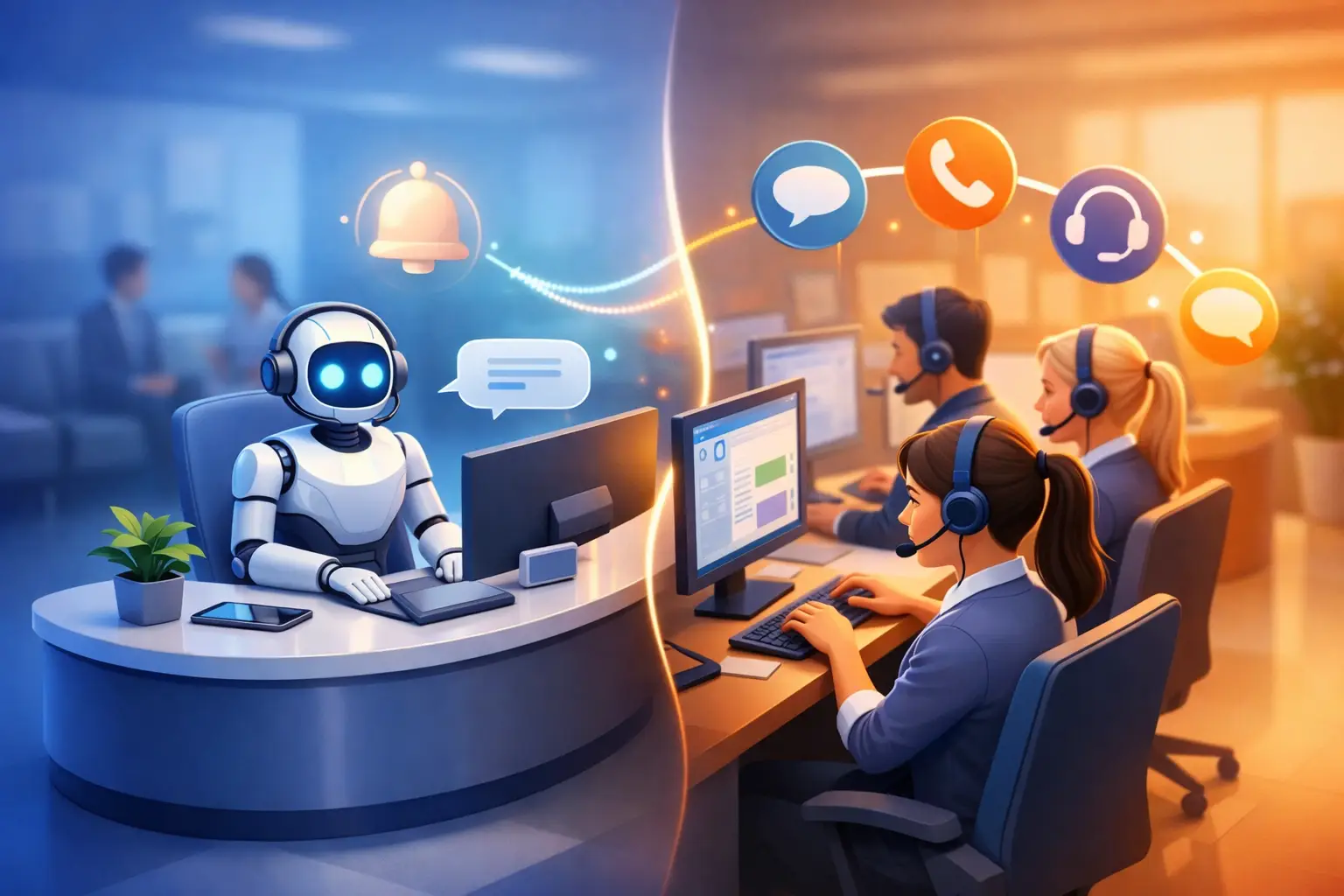
A missed call is rarely just a missed call for an appointment-driven business. It can be a patient who books elsewhere, a new client who never hears back, or a customer who gives up after being placed on hold. The front desk AI vs call center decision comes down to one operational question: which model reliably turns inbound interest into completed appointments without adding unnecessary cost or complexity?
Both options can extend coverage beyond a small in-house team. Both can reduce the pressure on staff during busy hours. But they are built for different jobs. A call center is primarily a staffed communication operation. Front desk AI is a dedicated reception layer designed to answer routine inquiries, capture details, route requests, and move qualified callers toward scheduling.
Front Desk AI vs Call Center: The Core Difference
A traditional call center relies on people to answer calls, follow scripts, document conversations, and escalate issues. It may operate after hours, during overflow periods, or as a fully outsourced customer-service function. Its value is human judgment, especially when a conversation is complicated, emotional, or outside a predictable workflow.
Front desk AI handles the repeatable work that creates bottlenecks at reception. It can answer common inbound questions, collect caller information, confirm availability, schedule or request appointments, send follow-up communications, and direct the request to the right person or process. Rather than functioning as a broad support department, it acts as a consistent first point of contact.
That distinction matters. If your primary need is appointment handling and fast response to new inquiries, a broad call-center service may provide more capability than you need while introducing more variability into the customer experience. If your business receives complex service cases that require deep product knowledge or careful issue resolution, human agents may still be the better first line.
Where Call Centers Perform Well
Call centers make sense when each conversation requires meaningful human discretion. For example, a caller may need a detailed explanation of a financial issue, a technical troubleshooting session, or help resolving a sensitive complaint. A trained agent can listen for context, adapt their wording, and make a judgment call that an automated receptionist should not make alone.
They can also be useful for organizations with highly variable call types. If inbound requests range from billing disputes and emergency escalations to account changes and detailed service consultations, a staffed team can provide a wider safety net.
The trade-off is operational control. Agent availability, training consistency, queue time, and script adherence can affect outcomes. Even a well-run call center must manage turnover, quality assurance, scheduling, and escalation protocols. For smaller service businesses, the cost of dedicated human coverage can be difficult to justify when a large share of calls involve the same few questions and scheduling requests.
Where Front Desk AI Delivers More Value
Front desk AI is strongest when speed, consistency, and appointment throughput matter more than extended conversation. A caller who wants to know whether you have availability, where you are located, what services you offer, or how to book should not have to wait for a human agent to become free.
An AI receptionist can respond immediately, including outside standard office hours. It can capture the inquiry while interest is high, gather the information your team needs, and keep the conversation moving toward a confirmed next step. That is particularly valuable for practices, local professional services, home services, and other businesses where the first response often determines who gets the booking.
Consistency is another advantage. A receptionist workflow does not become less accurate at the end of a long day or vary from one shift to another. When the underlying information, routing rules, and scheduling process are configured correctly, every caller receives the same current guidance.
For businesses evaluating Ortuas, this is the practical use case: a dedicated AI receptionist that covers inbound communication and appointment workflows without requiring another full-time front-desk hire. The objective is not to replace expertise where expertise is needed. It is to prevent routine reception work from slowing down the people who need to deliver the service.
Compare the Models by the Metrics That Matter
The right decision should be measured against front-desk outcomes, not simply answered-call volume. Start with response time. A call center may answer quickly when it is adequately staffed, but calls can still enter queues during busy periods. AI can provide immediate initial engagement at any hour, which gives a business a stronger position on speed-to-lead.
Next, assess booking conversion. Human agents can be effective, but their results depend on training and adherence to the booking process. An AI receptionist can consistently ask the required questions, offer the appropriate appointment path, and send confirmation messages. For high-volume, repeatable intake, that consistency can improve the percentage of inquiries that reach a scheduled appointment.
Then consider labor cost. Call-center pricing varies by call volume, minutes, agent level, and coverage hours. In-house staffing adds wages, benefits, training, coverage gaps, and management time. AI generally offers a more predictable software cost for routine communication workflows, especially when the alternative is hiring for evenings, weekends, or overflow.
Finally, look at the customer experience. Some owners assume customers always prefer a person. In reality, most callers first want a fast answer and a clear path to resolution. For a straightforward booking request, immediate help is usually more valuable than waiting for a live agent. The experience suffers when automation is used for conversations that require empathy or specialized judgment, so clear handoff rules are essential.
The Best Model Is Often a Layered One
This is not always an either-or choice. Many businesses get the best results by using AI for the front door and humans for exceptions. The AI receptionist handles first response, lead capture, basic questions, appointment requests, confirmations, and routine follow-up. Staff members take over when a request is urgent, complex, sensitive, or high value.
This approach protects staff attention. Instead of interrupting a receptionist or service provider for every ringing phone, the business can reserve human time for callers who genuinely need it. It also gives employees cleaner information when they do step in because the initial details have already been collected.
A call center can still have a role in this model if your operation needs live agents for complex after-hours support. But it should be evaluated as an escalation resource, not automatically as the default answer to every inbound call.
Questions to Ask Before You Choose
Before selecting a provider or workflow, review a representative sample of recent inbound calls. How many were appointment requests, basic questions, reschedules, status checks, or calls that could have been handled with accurate information and a defined process? Those are strong candidates for front desk AI.
Then identify the calls that require a person. These may include clinical or legal discussions, urgent matters, complaint resolution, custom estimates, or conversations involving sensitive account details. Your reception workflow should recognize these situations and route them without forcing callers through an unhelpful automated exchange.
Also examine your current gaps. If calls go unanswered during lunch, after business hours, while staff members are with customers, or during seasonal peaks, AI coverage can solve a clear operational problem. If the issue is poor training or lack of expertise among agents handling complex cases, a call-center contract alone may not solve it.
The best front desk system is the one that makes it easier for customers to take the next step. Build around the calls that generate appointments, set clear paths for human escalation, and make sure no inquiry disappears simply because the office was busy.
Get tips like this in your inbox
We send practical guides on AI, automation, and growing your service business. No spam.