AI Receptionist vs Virtual Receptionist
March 8, 2026
Compare ai receptionist vs virtual receptionist for cost, speed, coverage, and booking outcomes so you can choose the right front-desk model.
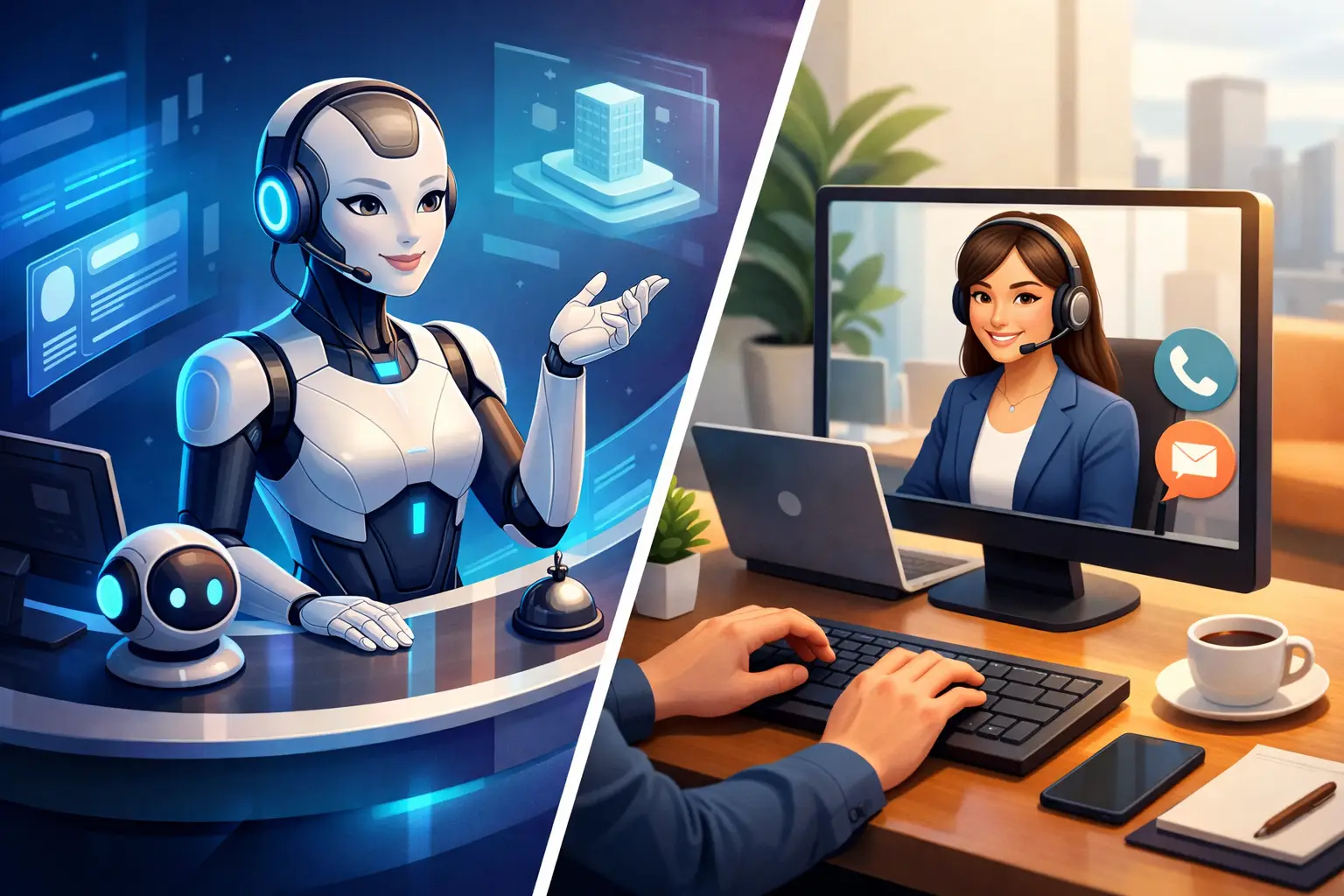
A missed call at 4:57 PM can turn into a lost appointment, a delayed follow-up, or a lead that books somewhere else by 5:05. That is why the real question is not whether your front desk needs support. It is which model protects revenue better when calls, texts, and booking requests keep coming.
When businesses compare ai receptionist vs virtual receptionist, they are usually deciding between two very different operating models. One relies on human coverage delivered remotely. The other uses automation built specifically to answer inquiries, handle scheduling, and keep communication moving without waiting on staff availability. Both can improve front-desk performance. The right choice depends on volume, complexity, hours of coverage, and how much consistency your operation needs.
What changes when you compare ai receptionist vs virtual receptionist
A virtual receptionist is a remote human who answers calls and handles front-desk tasks on behalf of your business. Depending on the provider, that can include taking messages, transferring calls, answering common questions, collecting intake details, and sometimes helping with scheduling.
An AI receptionist handles many of those same receptionist functions through software. It can answer inbound inquiries instantly, follow structured workflows, capture lead information, route questions, confirm appointments, and support ongoing customer communication. The key difference is not just that one is human and one is automated. The bigger difference is how each model performs under pressure, after hours, and across repetitive workflows that directly affect booking volume.
For appointment-driven businesses, reception is not only about answering the phone politely. It is about speed-to-lead, schedule accuracy, and making sure every inbound opportunity gets a response. That is where the comparison becomes operational, not theoretical.
Cost is only part of the decision
Many buyers start with labor cost, and that makes sense. A virtual receptionist typically involves ongoing service fees tied to call volume, minutes, or staffing tiers. If your inquiry flow rises, the cost often rises with it. Human support also carries limits. Coverage may be narrower after hours, during holidays, or when volume spikes unexpectedly.
An AI receptionist usually shifts the conversation from staffing cost to system capacity. Software can respond to every inbound inquiry at the same time, without requiring a larger team for basic coverage. That matters when your office gets bursts of calls before opening, during lunch, or right after a marketing campaign goes live.
But cost alone should not decide it. If your business handles highly sensitive situations that require judgment on nearly every call, a human-heavy model may still be worth the premium. If most of your inbound traffic follows repeatable patterns like scheduling, rescheduling, confirmations, service questions, or lead capture, automation often creates a better cost-to-performance ratio.
Speed and consistency usually favor AI
Response time shapes conversion. If a prospect reaches out and no one answers, your business may not get another chance. Virtual receptionists can improve responsiveness compared with an overloaded in-house team, but they are still bound by human queue time and shift coverage.
An AI receptionist answers immediately. There is no hold time caused by another conversation, no slowdown at peak hours, and no gap because it is early, late, or the weekend. That alone can improve lead capture and appointment throughput.
Consistency is the second advantage. Human receptionists, whether in-house or remote, vary by training, experience, and fatigue. They may phrase things differently, miss a step in intake, or forget to trigger the right follow-up. AI follows the workflow every time. For operators trying to standardize front-desk quality across locations or across long business hours, consistency is not a small benefit. It is the system.
Where virtual receptionists still make sense
This is not a case where one model wins every category. A virtual receptionist still has advantages in conversations that need flexible judgment, emotional nuance, or complex back-and-forth that does not fit a defined workflow.
If your front desk regularly handles unusual case intake, detailed insurance discussions, highly escalated callers, or requests that change direction mid-conversation, a trained human can sometimes move through that ambiguity more naturally. Some businesses also prefer a human presence for certain premium client interactions, especially if they believe personal rapport is central to the brand experience.
That said, many companies overestimate how much of their inbound communication truly requires that level of judgment. In practice, a large share of front-desk work is repetitive, time-sensitive, and process-driven. Those tasks are exactly where AI performs well.
Appointment handling is the dividing line
For service businesses, the most useful way to evaluate ai receptionist vs virtual receptionist is to focus on appointment handling. Can the system answer quickly, collect the right information, book accurately, confirm consistently, and reduce manual follow-up?
This is where AI often becomes the stronger operational fit. Appointment workflows are structured. They depend on clear rules, required fields, availability checks, confirmations, reminders, and follow-up communication. Software is well suited to that environment.
A virtual receptionist can help with scheduling, but the experience often depends on training depth, tool access, and how tightly the provider follows your process. If the process changes, retraining may be required. If call volume increases, execution can become uneven.
An AI receptionist is better positioned to run the same scheduling logic every time. That means fewer missed intake details, more reliable confirmations, and less admin cleanup for your staff. When the goal is to move inbound demand into booked appointments quickly, consistency tends to beat variability.
Coverage gaps are expensive
A front desk does not only fail when no one is hired. It fails when coverage is partial.
Many businesses have enough reception support during the busiest part of the day, but performance drops before opening, after closing, during lunch, or when staff are tied up with in-person visitors. A virtual receptionist can extend coverage, but it may still be limited by schedule, overflow rules, or service tiers.
An AI receptionist is built for continuous availability. It does not treat after-hours communication as secondary. It captures inquiries when they happen, not when the office reopens. For businesses that win or lose customers based on who responds first, that difference matters more than job title.
This is one reason companies adopt AI even when they already have staff. It fills the hours and scenarios where manual coverage is least reliable, while reducing the burden on the in-house team.
The best choice depends on call complexity and volume
If your inbound volume is low and most calls are unusual, a virtual receptionist may be sufficient. The cost may be acceptable, and the flexibility may match your needs.
If your business receives steady inquiries, relies on appointments, and loses revenue when calls go unanswered, AI usually has the edge. It scales without the staffing overhead that comes with growing phone volume. It also supports a more predictable customer experience, which is critical when response quality affects bookings.
For many businesses, the answer is not full replacement on day one. It is using AI as the primary layer for routine inquiries, scheduling, confirmations, and after-hours communication, while reserving humans for edge cases and escalations. That approach often delivers the best mix of efficiency and service quality.
What to ask before choosing
Before selecting either model, look past general claims and map the solution to your front-desk workload. How many inquiries come in outside business hours? How many calls are basic scheduling or intake? How often do leads go to voicemail? How much staff time is spent on confirmations, rescheduling, and repetitive questions?
Then ask a harder question: do you need more people answering the phone, or do you need a more reliable system for handling demand?
That distinction changes the buying decision. If the issue is occasional overflow with complex calls, a virtual receptionist may fit. If the issue is missed opportunities, inconsistent booking workflows, and too much manual coordination, an AI receptionist is usually the better upgrade.
Platforms built specifically for receptionist work, such as Ortuas, are designed around that operational reality. The goal is not generic chat. It is dependable front-desk coverage that captures inquiries, handles appointments, and keeps customer communication moving.
The better model is the one that protects response speed when your team is busy, keeps scheduling accurate when volume rises, and makes sure every inquiry has a next step. If your front desk is tied directly to revenue, choose the system that treats every call like it still counts at 4:57 PM.
Get tips like this in your inbox
We send practical guides on AI, automation, and growing your service business. No spam.