AI Receptionist vs Chatbots: Key Differences
March 27, 2026
AI receptionist vs chatbots: see which one captures leads, books appointments, handles calls, and improves front-desk efficiency.
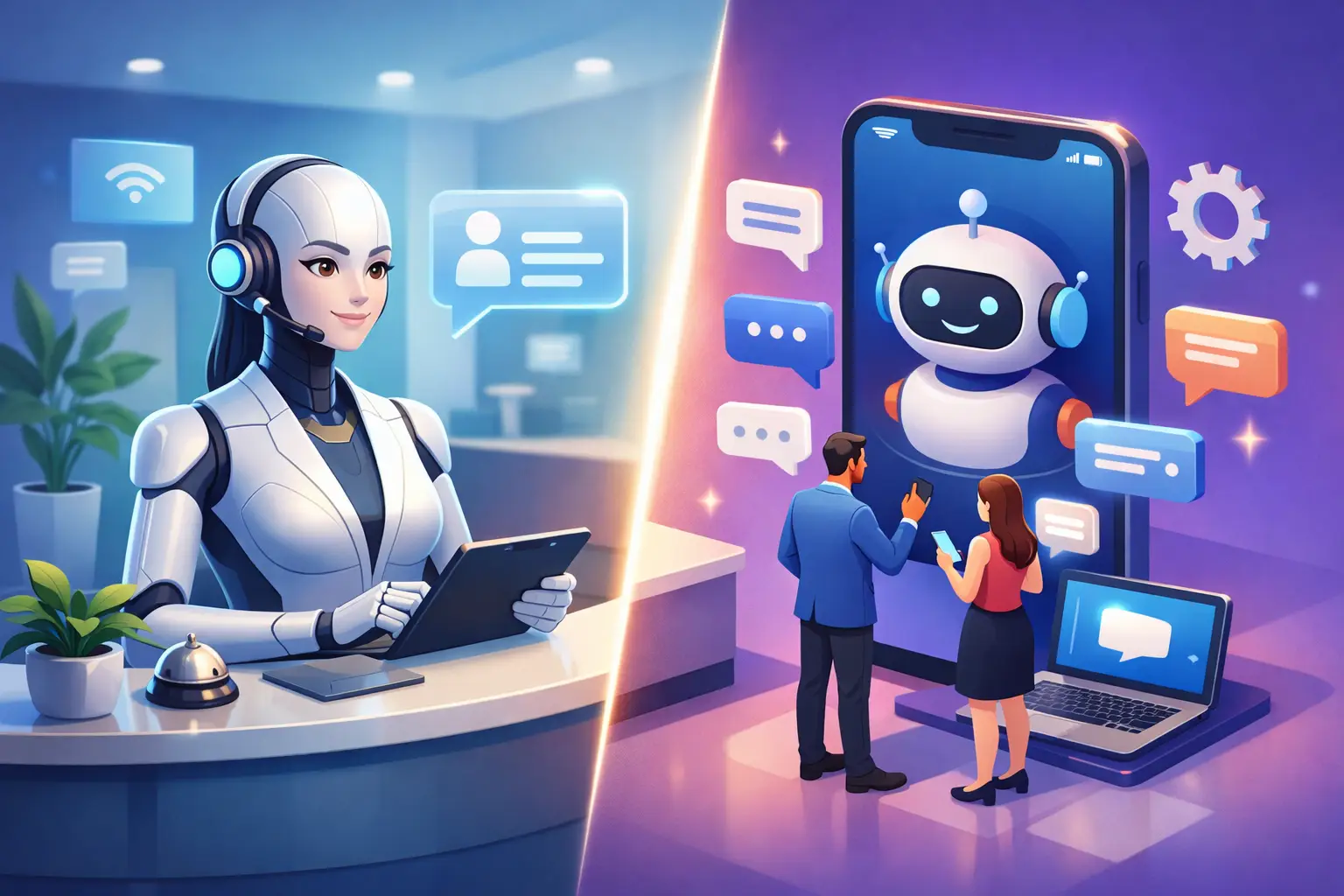
If your front desk misses calls, replies late to web inquiries, or struggles to keep scheduling organized, the difference between an AI receptionist vs chatbots is not academic. It affects lead capture, booking volume, staff workload, and how reliably customers get a response.
Many businesses use the word chatbot for any AI tool that talks to customers. That shortcut causes bad buying decisions. A chatbot can answer questions on a website or in a message thread. An AI receptionist is built to do front-desk work - handle inbound inquiries, guide conversations toward appointments, route requests correctly, and keep communication moving without gaps in coverage.
AI receptionist vs chatbots: the core difference
The simplest way to think about it is this: chatbots are usually conversation tools, while AI receptionists are operational tools.
A standard chatbot is often designed to respond to common questions such as hours, location, pricing basics, or service descriptions. It may live on a website, in SMS, or inside a messaging app. That can be useful, especially for reducing repetitive questions. But many chatbots stop at information delivery. They are not built around the front-desk outcome that matters most for service businesses: turning inbound demand into scheduled appointments and tracked follow-up.
An AI receptionist starts from a different job description. It is meant to cover the work a receptionist handles every day. That includes answering inquiries consistently, collecting customer details, qualifying intent, booking appointments, confirming next steps, and helping make sure no lead sits unanswered. The difference is not just the interface. It is the workflow.
For an office manager or owner, that distinction matters because front-desk performance is measured by outcomes, not just conversations. A polite answer is nice. A booked appointment is better.
What chatbots do well
Chatbots have a clear place in customer communication. If your business gets a high volume of repetitive questions, a chatbot can reduce interruptions for staff. It can provide immediate answers after hours. It can also give customers a quick path to basic information without waiting for a person.
For some businesses, that is enough. If inquiries are simple, appointment scheduling is limited, and your team can manually handle follow-up, a chatbot may solve part of the problem at a lower level of complexity.
Chatbots also work well when the goal is broad digital engagement rather than front-desk coverage. For example, if you want to greet visitors on your website, surface common answers, or direct users to a contact form, a chatbot can help.
The trade-off is that many chatbots are not strong at owning the entire intake and scheduling process. They can start a conversation, but they often hand off too early, rely on staff to finish the work, or create fragmented customer experiences across channels.
What an AI receptionist is built to handle
An AI receptionist is designed for businesses where responsiveness affects revenue. If missed calls become lost appointments, or if delayed follow-up reduces conversion, you do not just need answers. You need reliable front-desk execution.
That means the system should do more than respond. It should capture the inquiry, keep the interaction on track, collect the right booking information, and move the customer toward a confirmed next step. It should also maintain consistency whether the inquiry comes in during business hours, after hours, or during peak periods when staff is busy.
This is where a receptionist model is fundamentally different from a generic chatbot model. The value comes from replacing or supporting operational front-desk tasks, not simply creating another communication channel.
For appointment-driven businesses, the practical benefits are straightforward. More inquiries get answered. More customers get scheduled instead of waiting. Staff spend less time chasing voicemails, replying to routine intake messages, and cleaning up scheduling gaps.
Why service businesses often need more than a chatbot
In many service businesses, the front desk is a revenue function hiding inside an administrative role. When it performs well, appointments stay full, customers get fast responses, and the office runs on time. When it performs poorly, the damage shows up everywhere - lower conversion, frustrated staff, no-shows, and inconsistent customer communication.
That is why the ai receptionist vs chatbots decision should be based on process ownership. Ask a simple question: do you need a tool that answers, or a system that handles reception work?
If your business depends on inbound calls and appointment requests, partial automation usually leaves too much unfinished. A chatbot may answer the first question, but someone still has to collect details, coordinate scheduling, send confirmations, and close the loop. That means your staff remains the fallback layer for work the tool never really absorbed.
An AI receptionist is more valuable when your goal is to reduce that manual burden while improving response consistency. It is built for coverage, not just conversation.
AI receptionist vs chatbots in real operations
The differences become obvious when you look at daily office pressure.
A customer reaches out after hours wanting the next available appointment. A chatbot might provide office hours or suggest filling out a form. An AI receptionist should continue the interaction, gather what is needed, and move that person toward scheduling.
A surge of inbound inquiries hits during the lunch hour. A chatbot may answer basic questions, but edge cases and booking requests still pile up for staff. An AI receptionist is meant to maintain front-desk continuity when your team is unavailable or overloaded.
A returning customer needs confirmation, rescheduling, or next-step communication. A basic chatbot may not hold that workflow together cleanly. A receptionist-oriented system is designed around ongoing customer communication, not isolated messages.
These are not cosmetic differences. They determine whether automation reduces labor or simply rearranges it.
How to choose the right fit
The right tool depends on the role you need AI to play in your business.
If your main issue is repetitive website questions, a chatbot may be enough. If your real problem is missed inquiries, slow lead response, inconsistent booking follow-up, or front-desk staffing gaps, you likely need an AI receptionist.
It also depends on where your revenue risk sits. Businesses that rely on appointments should evaluate automation based on three outcomes: whether it captures every inquiry, whether it increases scheduling throughput, and whether it reduces manual front-desk work without creating customer confusion.
That framework usually makes the decision clearer. If the tool does not reliably help book, confirm, and communicate, it may be useful, but it is not functioning as reception coverage.
What to ask before you buy
When evaluating any vendor, avoid broad AI language and focus on operational specifics. Ask what happens when a customer calls or messages after hours. Ask how appointment requests are handled from start to finish. Ask whether the system supports routing, confirmations, and ongoing communication, or whether staff still need to step in for every meaningful action.
You should also ask how success is measured. Chatbot vendors may talk about engagement rates or conversation volume. For a service business, the more relevant metrics are response coverage, booked appointments, reduced missed opportunities, and less administrative load on your team.
That difference in measurement tells you a lot about the product category.
Where Ortuas fits
Ortuas is built around the receptionist function itself - capturing inbound inquiries, handling appointment workflows, and maintaining consistent communication so businesses can reduce missed calls and convert more demand into bookings.
That focus matters because many operators are not shopping for AI in the abstract. They are trying to fix a front-desk bottleneck. They need dependable coverage, not another tool that starts conversations and leaves the rest to staff.
The better question is not which is smarter
When businesses compare AI receptionist vs chatbots, they sometimes focus on which tool sounds more advanced. That is usually the wrong lens. The better question is which one is accountable for the outcome you need.
If your priority is simple question handling, a chatbot can be a practical fit. If your priority is making sure every inquiry is captured, routed, and moved toward an appointment, an AI receptionist is the stronger operational choice.
The best automation does not add novelty to your front desk. It removes missed opportunities, keeps scheduling moving, and gives your team fewer loose ends to manage tomorrow morning.
Get tips like this in your inbox
We send practical guides on AI, automation, and growing your service business. No spam.