AI Receptionist vs Answering Service
March 21, 2026
AI receptionist vs answering service: compare coverage, booking speed, consistency, and cost to choose the right front-desk model.
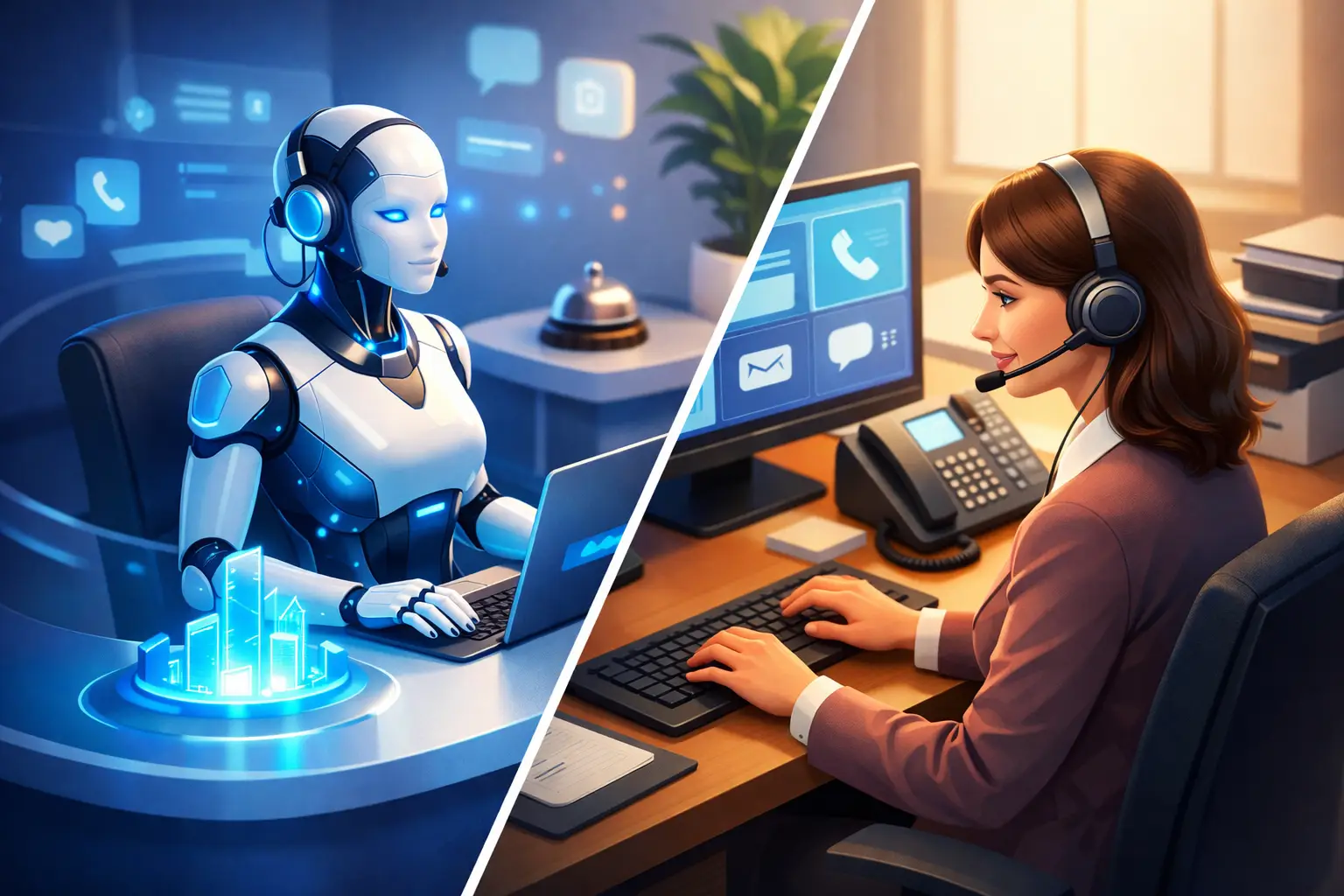
A missed call at 4:47 PM is rarely just a missed call. For an appointment-driven business, it can mean an unbooked consult, an empty slot tomorrow, or a lead that calls the next provider instead. That is why the choice between an ai receptionist vs answering service is not just about who picks up the phone. It is about how consistently your front desk turns inbound demand into scheduled revenue.
For many service businesses, both options sound similar at first. Each promises call coverage, fewer missed inquiries, and less pressure on staff. But operationally, they solve different problems. One is built to receive messages and provide basic coverage. The other is built to function like an active front desk layer that can answer questions, capture lead details, route conversations, and move people into the schedule.
AI receptionist vs answering service: the real difference
A traditional answering service usually acts as overflow coverage. It answers calls when your team is unavailable, takes a message, sometimes follows a script, and passes information back to your office. In some cases, it can transfer urgent calls or handle simple FAQs, but the process often stops short of completing the next step.
An AI receptionist is designed to carry the interaction further. Instead of just recording intent, it can qualify the inquiry, respond with consistent business information, handle appointment booking logic, and confirm or follow up as part of a defined workflow. That distinction matters when speed and completion rate affect revenue.
If your main problem is missed calls after hours, an answering service may cover the gap well enough. If your main problem is that inquiries are not getting booked quickly, or that staff spend too much time on repetitive front-desk communication, the AI receptionist model is usually the better operational fit.
Where answering services still make sense
Answering services are not obsolete. They can be a practical choice for businesses with low call volume, limited scheduling complexity, or a strong preference for human-operated message handling. If the goal is simply to make sure every caller reaches a live person and leaves contact information, this model can work.
They can also be useful in highly sensitive situations where a business wants a human voice for every interaction, even if that person is not embedded in the practice or office. Some operators value that human presence, especially for urgent or emotionally charged calls.
The trade-off is that coverage does not always equal resolution. If the caller still has to wait for a callback to get answers, confirm pricing, or book an appointment, your process adds another step. Every extra step creates another point where the lead can stall.
Where an AI receptionist changes the workflow
An AI receptionist is not just an after-hours backup. It is a system for handling front-desk activity with more consistency and less dependence on staff availability. That changes the workflow in ways that are easy to measure.
First, it improves speed to lead. When a prospect calls, texts, or submits an inquiry, the response can happen immediately. There is no queue for callbacks and no delay because the office is busy. For businesses that convert best when they respond fast, that matters.
Second, it supports direct appointment handling. Instead of taking a note that someone wants to book, the system can gather the needed details, present availability, and move the person toward a confirmed appointment. That reduces back-and-forth and helps fill the schedule faster.
Third, it standardizes communication. Human teams vary. Scripts drift. Training quality changes. An AI receptionist delivers the same core information every time, which is useful for businesses that want predictable handling across locations, shifts, or seasons of heavy demand.
Booking volume is where the gap becomes obvious
For an office manager or operations lead, the biggest question is usually not which option sounds better. It is which option produces more completed bookings with less admin work.
An answering service can preserve opportunity by making sure calls are not lost. That is valuable. But in many businesses, preserving opportunity is not enough. The front desk also needs to convert that opportunity. If the service only captures a message and your staff has to call back later, booking still depends on timing, follow-through, and whether the prospect answers.
An AI receptionist is better aligned to conversion because it is designed to complete the transaction path, not just document it. That is especially important for businesses where customers expect quick action, such as clinics, home services, legal intake, beauty and wellness, or any local service operation with high inbound demand.
When managers compare these models, they should look past call answer rate alone. A more useful metric is how many inquiries move from first contact to scheduled appointment without manual intervention.
Cost is not just the monthly fee
On paper, answering services can look straightforward. You pay for coverage, minutes, or call volume. AI receptionist platforms are also priced as a service, often with setup and workflow scope affecting cost. But the real comparison is broader than line-item pricing.
An answering service can create hidden labor downstream. Someone on your team still needs to review messages, return calls, answer repeated questions, and complete booking tasks. If your staff already struggles to keep up, message-taking may reduce missed calls while doing little to reduce administrative load.
An AI receptionist shifts more of that work into the system itself. That can reduce front-desk interruptions, lower overtime pressure, and limit the need to add staff just to keep up with inbound communication. The cost advantage becomes clearer when you account for saved labor, fewer dropped leads, and better schedule utilization.
This is also where consistency has financial value. Retraining humans is expensive. Coverage gaps from turnover are expensive. Missed details in scheduling are expensive. Automation does not remove every edge case, but it does reduce dependence on perfect execution from a busy front desk.
The customer experience depends on your use case
Some businesses assume callers will always prefer a human answering service. That is not universally true. Most customers care less about who responds and more about whether they get a fast, accurate, useful outcome.
If the interaction is simple, such as booking, confirming, rescheduling, or getting basic business information, speed usually matters more than the fact that a live operator answered. A caller who gets immediate help and a confirmed next step often has a better experience than one who speaks to a person who can only take a message.
That said, there are still cases where human escalation matters. Complex complaints, unusual billing questions, or highly emotional scenarios may need staff involvement. The strongest setup is often not all-or-nothing. It is a system where routine front-desk traffic is handled automatically and exceptions are routed appropriately.
How to choose between AI receptionist vs answering service
Start with the bottleneck, not the technology category. If your issue is basic phone coverage, an answering service may be enough. If your issue is missed bookings, slow response times, repetitive scheduling work, or inconsistent front-desk handling, you likely need more than message capture.
Look at what happens after the first contact. Does your business need someone to simply answer and relay? Or do you need the interaction to progress toward a booked appointment, a routed inquiry, or a completed communication workflow? The more your revenue depends on that next step, the more the AI receptionist model makes sense.
It also helps to review your current operating pattern. Businesses with after-hours demand, weekend inquiries, seasonal spikes, or lean front-desk staffing usually benefit more from automation that can act, not just respond. That is where a receptionist-specific platform such as Ortuas fits naturally - as a dependable layer for appointment handling and inbound communication, rather than a generic support tool.
The better question is what your front desk needs to accomplish
For most appointment-driven businesses, the decision is not about replacing humans for the sake of it. It is about building a front desk process that captures every inquiry, handles routine communication reliably, and keeps the schedule moving without adding staffing strain.
If you only need a safety net, an answering service can do the job. If you need a front desk function that actively supports booking, consistency, and operational efficiency, an AI receptionist is the stronger system.
The better choice is the one that closes the gap between inbound demand and a confirmed next step. That is where front-desk performance stops being reactive and starts producing measurable throughput.
Get tips like this in your inbox
We send practical guides on AI, automation, and growing your service business. No spam.