After-Hours Calls That Still Book Appointments
February 20, 2026
After hours call answering for appointments helps you capture leads, book faster, and reduce no-shows with consistent scheduling and follow-up.
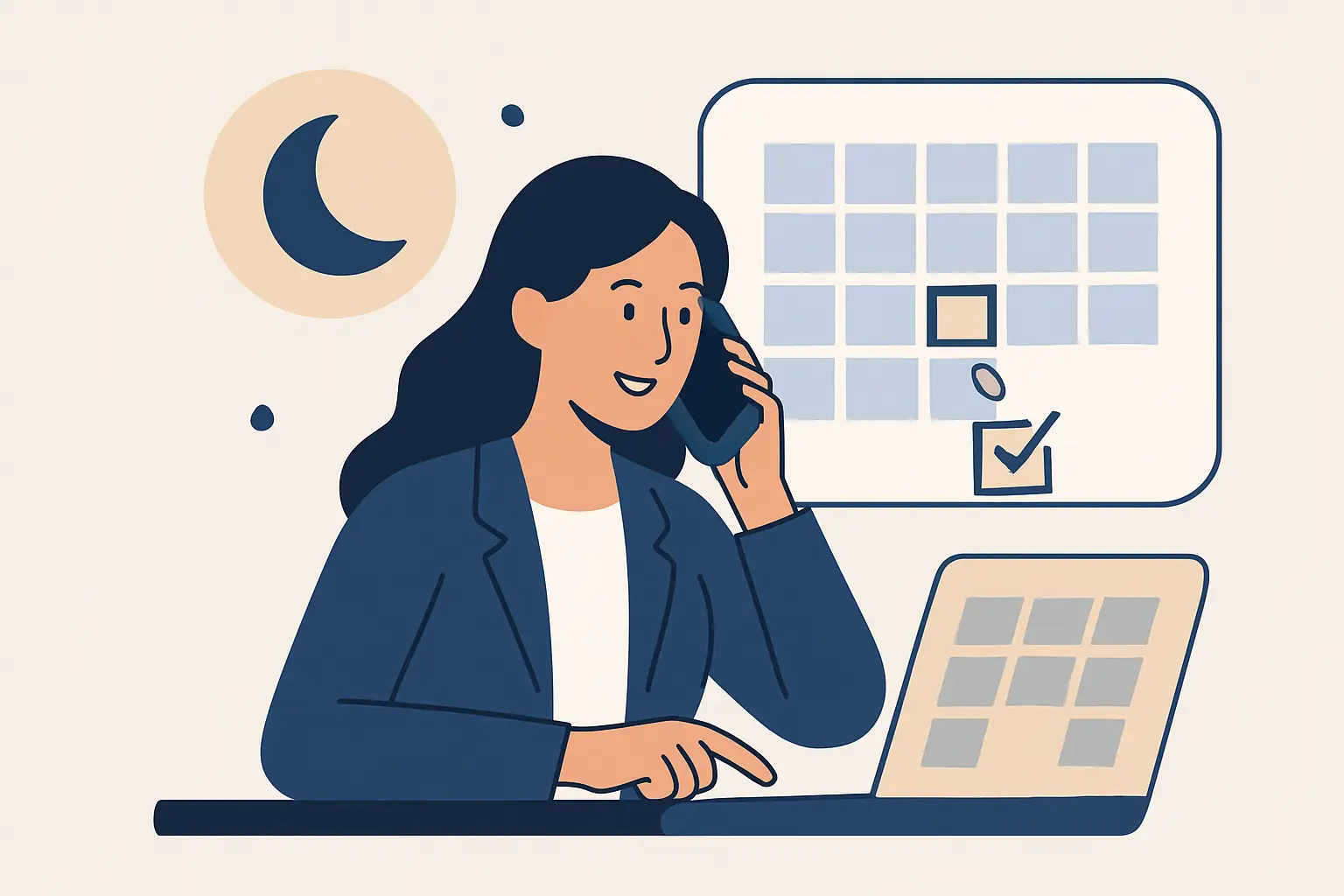
Your phone rings at 7:18 pm. It is a new prospect who finally has time to call, and they want the first available appointment. If nobody answers, you do not just lose a call. You lose momentum. By the time your team calls back tomorrow, that person may have already booked with the competitor who picked up.
That gap between when people reach out and when you respond is where appointment businesses quietly bleed revenue. After hours call answering for appointments is not about being “nice to have” or offering white-glove service. It is an operational control point: capture the inquiry, convert it into a scheduled slot, and keep the customer moving forward without adding front-desk headcount.
Why after-hours calls matter more than you think
Most appointment-driven businesses staff for peak hours and accept that evenings, lunches, and weekends are coverage gaps. The issue is that demand does not follow your staffing plan. Prospects call when they are off work, when they remember, or when the need becomes urgent. Existing customers call after hours because that is when they notice a problem, review their calendar, or try to reschedule.
Operationally, missed after-hours calls create three predictable outcomes. First, you lose speed-to-lead. Second, you force your team into reactive call-back queues that compete with daytime workload. Third, you increase the chance of miscommunication because you are trying to reconstruct intent from voicemail instead of handling it live.
If your revenue depends on appointment throughput, treating after-hours coverage as optional is usually a hidden constraint on growth.
What “after hours call answering for appointments” should actually do
Not all call answering is appointment handling. A basic answering service can take messages, but that still leaves your staff to interpret, call back, and schedule. What you want after hours is the same outcome you expect at 10:00 am: a booked appointment with the right details captured.
For after hours call answering for appointments to be effective, it needs to consistently do four things: identify the caller’s intent, gather the minimum required booking information, schedule into the correct calendar rules, and confirm next steps in a way that reduces no-shows.
That sounds simple until you consider real-world conditions. Callers are often in a hurry. They do not know what information you need. They may be comparing providers. They may need to understand pricing, service boundaries, or whether you accept their insurance. They may want to book for someone else. The solution has to handle those paths cleanly, without improvising and without forcing the caller into a dead end.
The operational trade-offs: humans, voicemail, or automation
After-hours coverage usually comes down to three approaches, each with trade-offs.
Voicemail is the cheapest and the least effective. It pushes work into tomorrow, increases drop-off, and creates a quality problem because your team starts the day returning calls instead of moving the schedule forward.
On-call staff or overtime can work if volume is low and expectations are clear, but it is hard to scale. You also risk inconsistent call handling. The person covering after hours may not be your best scheduler, may not have system access, or may simply be tired. Even if they do a good job, the cost per booked appointment can be high.
Automation, when designed specifically for receptionist workflows, can give you consistent coverage without staffing overhead. The risk is choosing something generic that can “chat” but cannot execute scheduling correctly, or that makes promises it cannot keep. For appointment businesses, the bar is not conversational ability. The bar is accurate booking and reliable follow-through.
What strong after-hours appointment handling looks like in practice
The best systems behave like a high-performing front desk: efficient, specific, and process-driven.
They start by controlling the intake. Instead of letting the caller ramble and hoping the right details appear, the flow should confirm who is calling, what service they need, and what location or provider they are trying to reach. This is where many businesses see immediate gains because it reduces back-and-forth and prevents appointments that are impossible to fulfill.
Next is eligibility and rules. Some appointment types require lead time. Some require specific staff. Some cannot be booked for first-time patients without additional information. After-hours answering should enforce your policies the same way your best receptionist would. If it cannot book, it should route to the right next step, such as capturing details for a priority follow-up or offering alternative slots.
Then comes scheduling itself. The system needs to avoid double-booking, respect buffers, and handle cancellations and reschedules without leaving gaps or creating calendar chaos. This is where “message taking” stops being helpful and true appointment handling begins.
Finally, confirmation is not optional. A booked slot is only valuable if the person shows up. Effective after-hours appointment handling includes clear confirmation of time, location, preparation requirements, and what to do if they need to change plans.
Where after-hours answering improves revenue, not just service
Operators often justify after-hours coverage as customer experience. That is real, but the measurable impact tends to show up in three places.
First is conversion. When a caller can book immediately, you reduce the time and friction between intent and commitment. That is a direct lift in booked appointments.
Second is schedule utilization. After-hours handling is not only about new bookings. It also captures cancellations and reschedules when people are most likely to deal with their calendar. If those changes happen in real time, you have more daylight hours left to refill openings instead of discovering empty slots the next morning.
Third is staff leverage. Every call that is answered, qualified, and scheduled correctly after hours is one less interruption and one less manual workflow for your team during the day. That reduces the need for additional front-desk hiring as volume grows.
The nuance: if your business is already operating at capacity with a waitlist, after-hours answering may not increase total volume. It will still reduce administrative load and improve consistency, but the revenue lift may come from higher-value scheduling, fewer errors, and less leakage from missed calls.
The details that make or break after-hours appointment capture
After-hours appointment answering fails when it is treated like a generic inbound call problem. Appointment-driven businesses need receptionist-grade execution.
Accuracy is the first constraint. Misheard names, wrong phone numbers, and incomplete service details create more work than they save. Strong solutions confirm critical fields and repeat them back.
Controlled scope is the second constraint. After hours, you do not need to solve every edge-case. You need to handle the majority path cleanly and route exceptions appropriately. That might mean capturing details for a morning callback when the request requires specialized pricing, clinical judgment, or manager approval.
Brand consistency is the third constraint. Callers should hear the same policies and the same tone every time. Inconsistent messaging creates disputes and no-shows. After-hours answering should reinforce your requirements, deposits, cancellation policies, and arrival instructions the same way your team does.
Compliance and privacy matter as well. Depending on your industry, you may need to limit what is collected or spoken over the phone, control access to records, and ensure sensitive data is handled appropriately.
How to evaluate an after-hours answering solution
If you are comparing options, evaluate them like an operations lead, not like a shopper.
Start with outcomes: can it actually book, cancel, and reschedule appointments into your system, or is it just capturing messages? Then test realism: how does it handle a caller who does not know what they need, who asks about pricing, or who wants the first available slot next week after 6 pm?
Next, look at configuration control. Your front desk works because it follows rules. The solution should let you define services, locations, hours, buffers, lead times, and escalation paths. If you cannot adjust it easily, you will end up with workarounds that drag your team back into the loop.
Finally, audit the handoff. For anything that cannot be booked after hours, you should still wake up to a clean, prioritized queue with complete details and context, not a stack of vague voicemails.
When an AI receptionist is the right fit
An AI receptionist makes the most sense when your call volume is meaningful outside standard hours, when missed calls correlate with lost bookings, and when your team is already busy enough that callbacks get delayed.
It is also a strong fit when your front desk performance varies by staff member or shift. Automation standardizes the process so every caller gets the same booking experience, the same policy messaging, and the same confirmation workflow.
If you want a purpose-built option focused specifically on receptionist work - answering inbound inquiries, scheduling, and confirmations - Ortuas provides an AI receptionist that covers after-hours appointment handling as an automation layer for the front desk (https://ortuas.com).
The key is fit. If your appointment types require complex triage that cannot be standardized, you may still need human coverage for those specific calls. In that case, after-hours automation can handle the routine scheduling and intake, while escalating only the exceptions.
Designing your after-hours workflow so it actually sticks
After-hours coverage works best when it is treated as a defined workflow, not a patch.
Decide what you want booked automatically versus what should be captured for follow-up. Set clear guardrails for edge-cases. Make sure your policies are explicit so callers get consistent answers. Then measure what happens: booked appointments after hours, missed call rate, average time-to-confirmation, and the percentage of calls that still require staff intervention.
If you do this well, after-hours answering stops being “coverage.” It becomes an extension of your scheduling engine.
Keep the goal simple: when people are ready to book, your business should be ready to book too.
Get tips like this in your inbox
We send practical guides on AI, automation, and growing your service business. No spam.